Journal
How to Choose a Locking Steel Collar
Updated
A steel collar is the piece people agonise over most, and reasonably so: it is worn at the throat, it is often worn longest, and unlike a soft collar it will not stretch to forgive a bad decision. This guide is about the decision that comes first and gets the least attention — how the thing closes. Weight, discretion and sizing each have their own guide, linked at the end.
The four closures, and what each one costs you
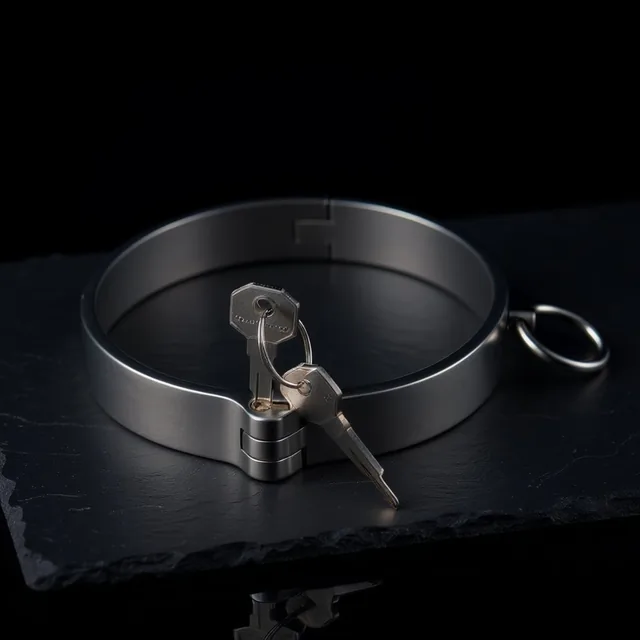
Integrated pin-lock. A sliding bolt built into the band itself, turned by a key. Nothing dangles at the throat, nothing snags on bedding or a shirt, and the key leaves with whoever is not wearing it. This is the closure used on the Sovereign and the Regent—closed, the throat carries one clean line of steel. The trade is that a pin-lock is a simpler mechanism than a cylinder: it is a fastening, not a security device.
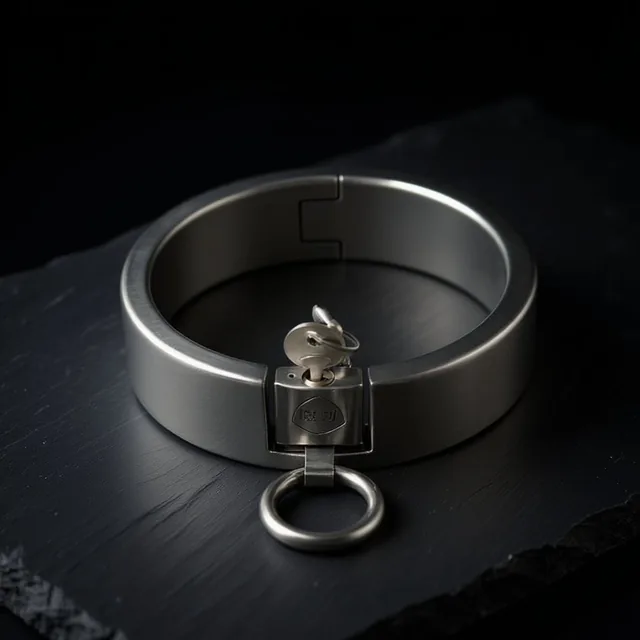
Recessed cylinder lock. A proper keyed barrel sunk into the band. Smoother to open and it sits as flush as a pin-lock does. The Bastion and the Cardinal use this. It costs more to make, which is most of why it is less common.
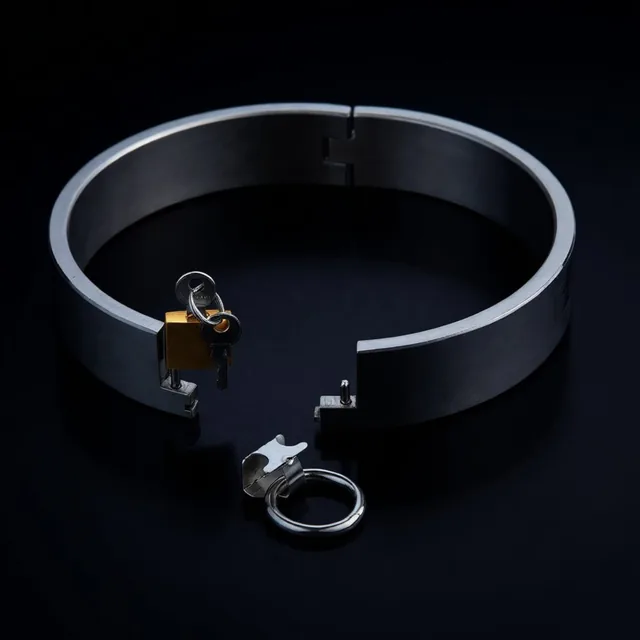
Padlock through a hasp. The cheapest and the most visible: a lock hanging at the front. It is genuinely functional and it has one real advantage — you choose the padlock, so you choose how serious it is and who holds a key. Against that, it swings, it catches, it presses into the collarbone when you lie down, and it is legible from across a room to anyone who has ever seen a padlock.
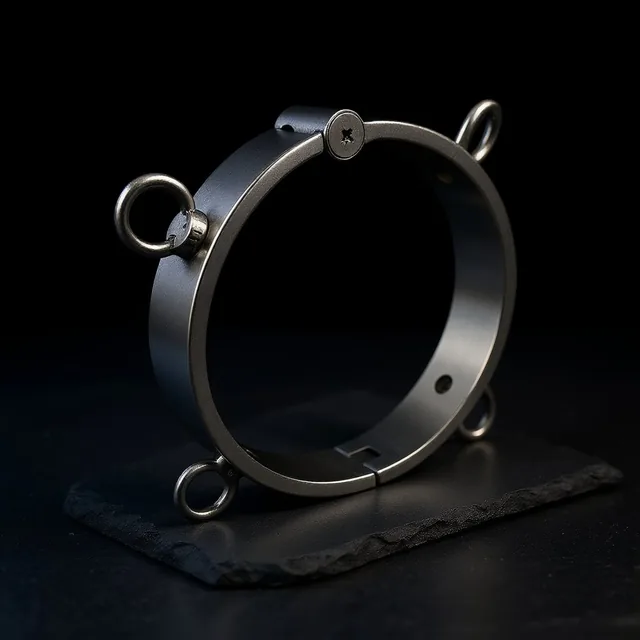
Screw closure. No lock at all; a countersunk screw and a driver. It cannot be sprung, cannot be palmed, and cannot be undone in a moment of doubt — which is exactly the point, and exactly the risk. Screw-closed vs key-locked covers what that changes.
The question that actually decides it
Not "which is strongest". Ask instead: who needs to be able to open this, and how fast?
If the answer is "either of us, immediately" — a session, a scene, anything where circumstances change — you want a key, and more than one copy of it. If the answer is "not in a hurry, and that is the idea", a screw makes sense, and the planning shifts to where the driver lives and who can reach it.
Everything else about a collar is preference. This part is not.
What to check in a listing
- Is the lock in the band, or hung on it? One photograph of the collar closed, from the front, answers this.
- How many keys ship? More than one, and know where the spare lives before you need it.
- Are keys shared across the range? Useful if you own several pieces; worth knowing either way.
- Is there a photograph of it open? If not, you cannot see the hinge, the lock body, or the inner edge — and those are the three things that decide whether it is well made.
The grade, briefly
Because it rests against skin for long periods, a collar is where the exact material and finish matter most. Check the individual listing rather than assuming every silver-coloured piece is 304, and do not treat “nickel-free” as established without evidence. The reasoning is in 304 vs 316.
Then the other three decisions
- How heavy? — How heavy should a steel collar be?
- Will it be noticed? — Collars you can wear in public
- What size? — Measuring for fit. Measure before use so an unused wrong size can still qualify for exchange under the return policy.
The full range is in steel collars.
The pieces this is about