Journal
One Ring or Four? What the Rings on a Collar Are Actually For
Updated
Almost every steel collar has a ring at the front. Some have four. The difference is not decorative, and it is not about how much hardware you get for the money — it changes what the collar is for in a way that is easy to miss when you are comparing photographs.
A single front ring makes the throat a destination
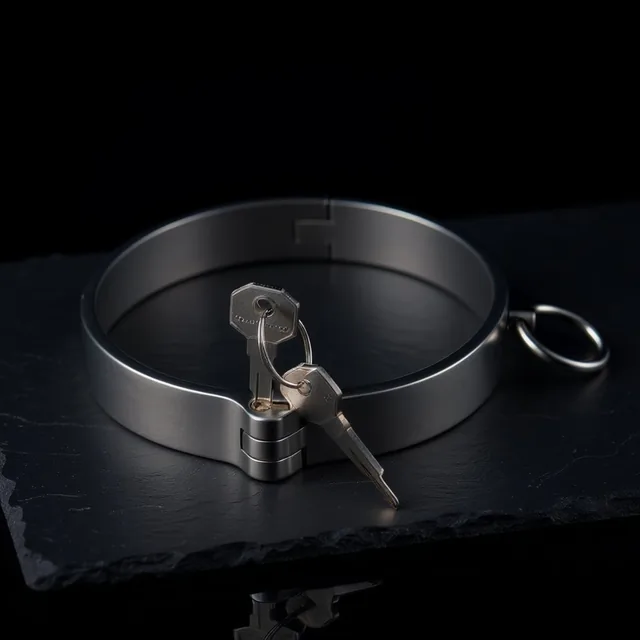
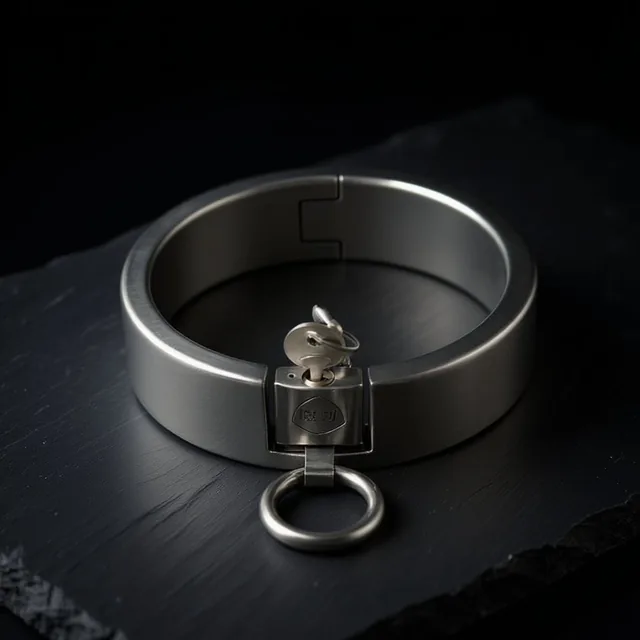
One ring, centred at the front, has one obvious use: a lead. Everything that attaches, attaches there, and everything that attaches pulls forward. That is exactly right for the classic picture — a collar and a lead, one person leading, one following — and it is why the single ring became the default.
It also has a quiet advantage. One ring means one place for a hand to find in the dark, and nothing at the sides or the back to press between the wearer and a chair, a wall, or a mattress. If the collar is going to be worn rather than used, fewer protrusions is a real comfort argument. The Sovereign and the Regent are both built this way.
Four rings make the throat a junction
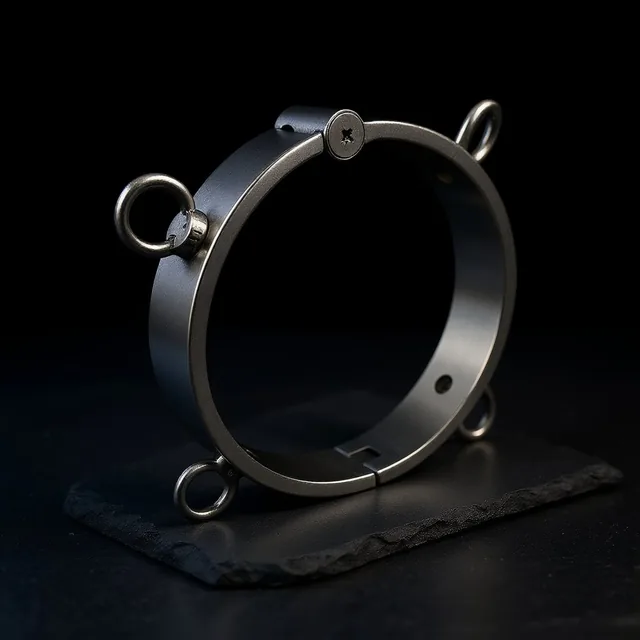
Put a ring at the front, the back and both sides and the collar stops being the last piece you put on. It becomes the piece everything else routes through: a lead forward, a chain back, a clip to either side depending on where the wearer actually is. The Cardinal is built this way — four welded rings on a 3 cm band, with the lock recessed into the band rather than hung on a hasp.
The practical gain is that you stop routing every connection through one point at the front of the throat. If the position calls for a line running back over the shoulder, there is a ring back there for it, and nothing has to be looped around the band to get it.
What rings are not
Rings are attachment points, not lifting points. We publish no load rating for any ring on any piece we carry, and nothing in the range — collar, cuff, bar or set — is represented, tested or sold to carry body weight. A welded ring on a collar is there to take a lead or a light chain. It is not an anchor, and the neck is the last place on the body you would want to discover the difference.
Ring construction, briefly
Three things are worth looking at in a listing photograph:
- Welded or screwed? A welded ring has no thread to work loose. A screwed one can be replaced but should be checked before each wear.
- Round bar or flat lug? Round bar takes a clip smoothly from any angle. A flat drilled lug is stronger for its size but needs the clip presented squarely.
- Does it sit proud or sit flush? A ring that stands away from the band is easy to clip and easy to catch on bedding. Both are true; pick the one that matches how you will actually use it.
Choosing between them
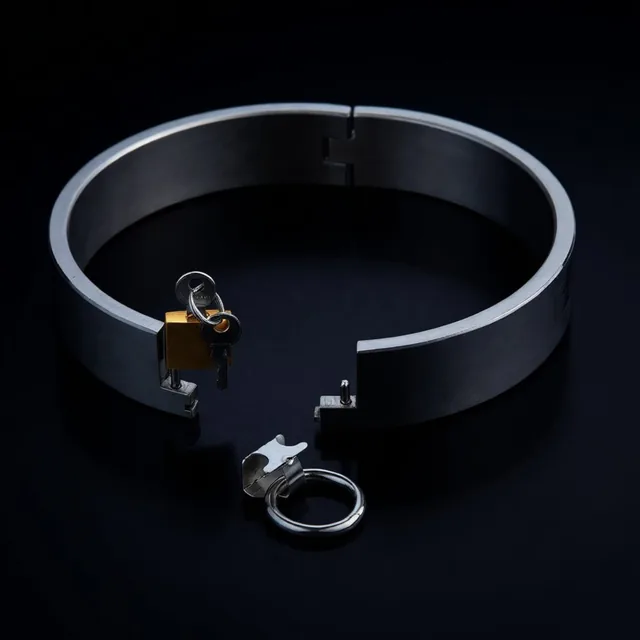
If you want one collar and you mostly picture a lead, one ring is the cleaner object and the more comfortable one to wear all day. If you already own cuffs and chain and you find yourself improvising a route around the band, four rings is the piece that stops the improvising. Both are in steel collars.
The pieces this is about