Journal
Screw-Closed vs Key-Locked: Restraints You Wear, Restraints You Apply
Updated
Most steel restraints open with a key. A few close on a screw and need a driver. That sounds like a small manufacturing detail. It is actually the difference between a piece you apply and a piece you simply have on, and it changes almost everything about how you should choose.
What a key buys you
Speed, in both directions. A key-locked cuff or collar goes on in a second and comes off in a second, by anyone holding the key. That is the right property for a session: things change, someone needs the bathroom, someone's hand goes cold, and the answer is one turn away.
It also changes the release plan. Check what the individual listing includes, test every supplied key before use, and keep the working release key somewhere findable in the dark.
What a screw buys you
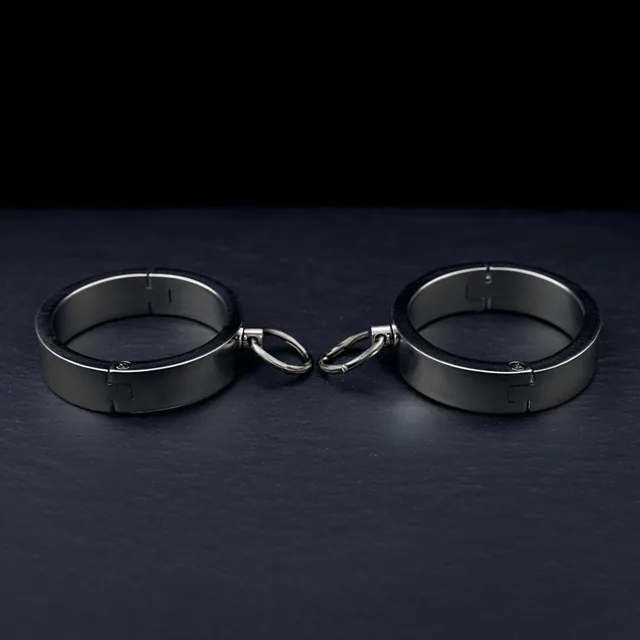
Deliberateness. A countersunk screw does not come undone in a moment of doubt, cannot be palmed, and does not spring. Taking the piece off is a small job with a tool — a minute, both hands, and light. The Ballast ankle bands close this way: a countersunk screw in each band, and a welded ring on each — the two bands are independent of one another unless you clip something between them.
That minute is the whole point. A screw-closed piece suits wearing under clothes rather than being applied in a scene — the question it answers is not "how do we get out of this quickly". How long anyone leaves one on is their decision and not something a shop should be prescribing; what we will say is that the longer it is on, the more the fit checks below matter.
The trade you are actually making
| Key-locked | Screw-closed | |
|---|---|---|
| Time to remove | Seconds | A minute, with a tool |
| In an emergency | Fine, if a key is to hand | Needs the driver — plan for it |
| Suits | Sessions, scenes, anything supervised | Being worn rather than applied |
| Failure mode | Lost key | Rounded screw head, seized thread |
Neither is safer in the abstract. A key-locked piece with the key in another room is more dangerous than a screw-closed piece with the driver on the nightstand.
Rules for anything that needs a tool
- Keep the tool where the wearer can reach it. If the driver lives with someone else, then removal depends on that person being present and awake. That is a decision to make deliberately, in daylight — not a default to drift into.
- Check the fit repeatedly, and more often than feels necessary. Ankles and wrists swell in heat, in the evening, after exercise, on long flights, with illness and with medication. A fit that was right on one day can be wrong on another. One to two fingers of clearance, all the way round, every time.
- Do not overtighten. The thread is in steel. Snug is enough; force rounds the head and turns a one-minute job into a hacksaw.
- Do not sleep in something you cannot remove yourself. If that is the intention anyway, it is a conversation to have with the person who will be there, not a thing to find out about at three in the morning.
- Anything that hurts, numbs, tingles or goes cold comes off, and the fact that removal takes a minute is exactly why you do not wait to see whether it settles.
- Keep blunt-nosed safety shears nearby for anything soft in the rig, and remember that shears do nothing at all to steel.
Choosing
If this is your first metal piece, buy key-locked. Learn how a machined fit behaves on your own body before you choose something that takes a tool to undo. If you already know that, and what you want is the quiet fact of a thing that is simply on, that is what a screw is for. Both kinds are in metal handcuffs, ankle cuffs and leg irons and steel collars.
The pieces this is about