Journal
Choosing Your First Restraints
Updated
The usual first purchase is a bundle: four cuffs, a blindfold, some webbing, a printed box, €30. It is a reasonable way to find out whether you are interested, and a poor way to find out what good equipment is like — everything in it is designed down to a price, and the failure modes stay hidden until they arrive.
Start with one point of contact
Buy one thing that works properly rather than six that approximately do.
For most people that is the Oath Wrist Shackles at €79. Wrists are the most useful joint to restrain, the easiest to fit correctly, and the easiest to release quickly.
If you would rather start with a stance than with a joint, the Oath Ankle Shackles at €89 run a rigid bar where others use a chain, so the position is set rather than merely shortened.
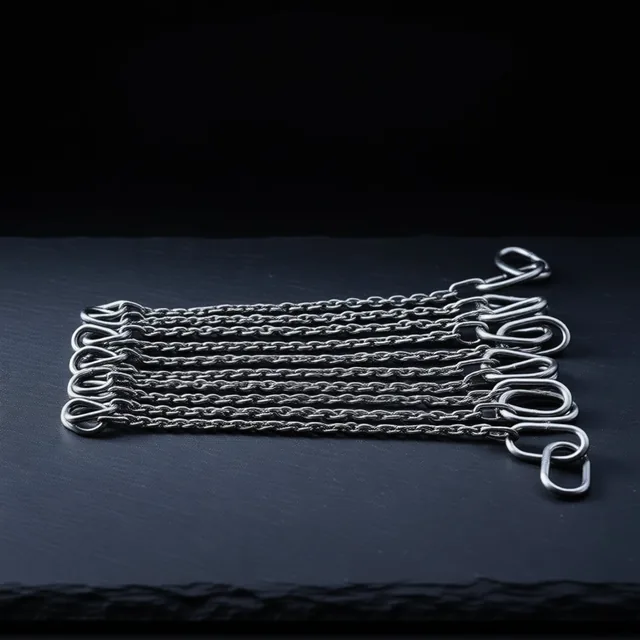
The natural second purchase is the Vantage Adjustable Spreader Bar at €89 — three sections that lock at seven positions between 62 and 93 cm. Set it near the low end, close to shoulder width, and it introduces a single new axis of control. Add the Duet Chain & Clip Set at €49 and every piece you own connects to every other piece.
If you already know where this is going, the Foundry Complete Set at €199 is the consolidated route and costs less than assembling the same pieces individually.
Why metal, specifically
Not for the look. For predictability.
Cheap sets fail in ways you cannot inspect. Nylon webbing stretches under sustained load, so a fit that was correct at the start is loose ten minutes later. Hook-and-loop closures lose grip progressively and then release all at once, usually at the least convenient moment. Plated pot-metal hardware flakes at the edges and exposes a base metal that stains skin. Split rings deform and stop closing. None of these announce themselves in advance.
Machined steel has the opposite property: it behaves the same way every time, and when something does go wrong it is visible before it matters — a hairline in a weld, side play in a hinge, a spring gate that no longer snaps shut. Ten seconds of inspection tells you where you stand.
There is a plain economic argument too. A €79 pair of shackles that lasts a decade and takes replacement parts is cheaper than three bundles, and well under the €150 to €590 European workshops charge for hand-built equivalents.
The parts that are not hardware
Equipment is the least important thing here. These are:
Agree before, not during. Decide what is happening, what is not, and how long, while everyone is clear-headed and dressed. Not while restrained. Not after drinking.
A safeword, and a non-verbal signal. A word that stops everything immediately, plus something that works when speech does not — a held object dropped on the floor is the standard, because it is unmistakable and requires no coordination.
Continuous monitoring. Release immediately for pain, numbness, tingling, coldness, swelling or colour change. A clock interval or internet “two-second test” cannot establish a medically safe duration for an individual.
Keys and shears within arm's reach. Blunt-nosed safety shears, tested, in the same place every time. If you cannot free someone in seconds in the dark, you are not ready to restrain them.
Never leave a restrained person unattended. Not to answer the door, not to fetch something.
Nothing in this store bears weight. No restraint hardware we carry is rated to suspend or support a body. Suspension requires purpose-rated rigging equipment and competent practice; this collection is not that equipment.
Buy one well-made thing, learn to fit it, and practise releasing it quickly. The rest of the range will still be here.