Journal
Choosing a Bondage Cross That Does Not Need Wall Fixing
Updated
A cross or frame is the largest, most expensive and least returnable thing in this category, and it is the one where the listing photograph tells you least. Three questions decide whether the one you are looking at will work in your home, and none of them is about how it looks.
One: free-standing or wall-fixed?
Wall-fixed frames are cheaper, more rigid, and permanent. They also require drilling into a structural wall, which rules them out for most renters and for anyone who does not want a conversation about it.
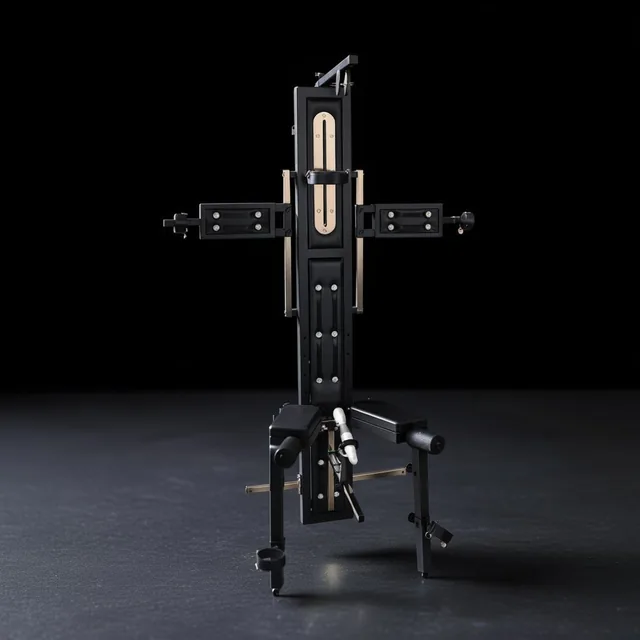
Free-standing frames stand on their own base. They cost more, they take up floor area even folded, and their stability depends entirely on the base geometry rather than on your masonry. Our Atlas is free-standing, roughly 190 cm tall, with no wall fixing.
If you rent, this is not a preference. It is the whole decision.
Two: does it actually fit the room?
Three measurements, in this order:
Ceiling height. A 190 cm frame needs meaningfully more than 190 cm of ceiling, because it has to be tilted up into place during assembly. A room that clears the frame standing may still not clear it going up. Measure the ceiling, and think about the diagonal rather than the height.
Floor footprint including the base. The visible frame is not the footprint. Free-standing bases extend well beyond the uprights, and that is the number that decides whether a door still opens.
The route in. Doorways, stair turns and lift dimensions. Flat-packed frames ship in long boxes, and a long box does not go round a tight landing.
Three: how does it get out of sight?
Almost nobody asks this before buying and almost everybody asks it after. Some frames fold; some come apart with a hex key; some do neither and simply live in the room. Any of those can be the right answer — but discovering which one you bought after it arrives is the wrong order.
What to look at in the photographs
- The base joints. Where uprights meet the base is where a free-standing frame fails. Look for welds and gussets, not a single bolt through a tube.
- Adjustability. Sliding, bolt-locked arms let one frame fit different people. Fixed arms fit one.
- Attachment points. Cuff brackets and rings should be part of the structure, not screwed to a face panel.
- Padding. Anywhere a body rests against bare steel for any length of time wants a padded panel, and panels get grubby — check whether they are removable.
Delivery and returns, before you click
Large frames travel by freight, not parcel. That means a longer transit, a phone call to arrange delivery, and kerbside or ground-floor drop — the driver will not carry it upstairs. It also means return shipping is substantial if you change your mind, so measure before you order rather than after. Our own terms for freight items are set out in shipping and returns.
And the boundary we do not move
No frame we sell is rated to suspend a person or bear body weight, including every ring, bracket and arm on it. It is a station to be restrained against while standing, kneeling or seated — not an anchor to hang from. Suspension is a separate discipline with its own rated hardware and its own training.
The frame is in furniture.