Journal
Chain, Clips and Connectors: Making Pieces Work Together
Updated
The most common frustration in metal restraint is not that a piece is uncomfortable. It is that two pieces will not connect. A hook that will not pass through a ring, a chain that is six inches too short, a padlock whose shackle is too fat for the lug — all of it discovered at the worst possible moment. This is how to stop that happening.
The three numbers that decide compatibility
Ring inner diameter. Everything attaches to a ring, and the inner diameter is the clear opening the hook has to pass through. A ring can look generous in a photograph and still be made of bar thick enough that a hook's gate will not close around it — which is the next number.
Hook nose and gate opening. For a hook to seat on a ring, the gate has to open wider than the ring's bar, and the nose has to pass through the ring's opening. Two numbers, not one, and sold separately they are almost never printed on the same page. It is a common reason two pieces will not connect, and a large part of why kits exist.
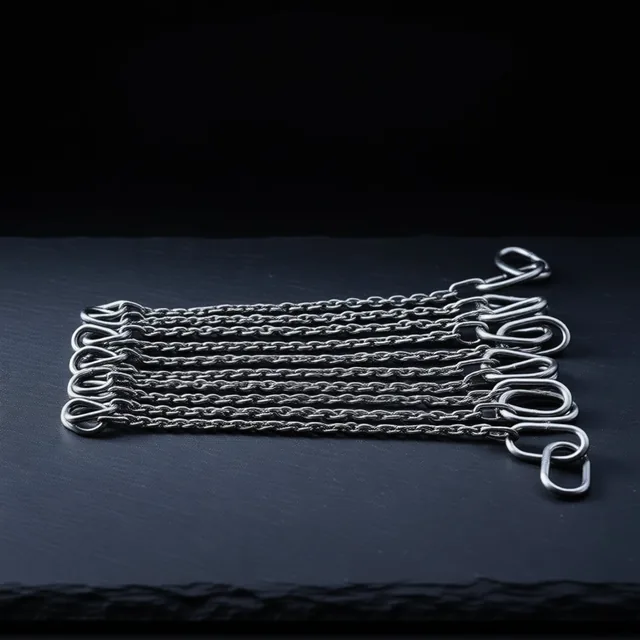
Chain link opening. A chain attaches by passing a link over a hook, so what matters is the inside of the link, not the wire it is made from. Our Duet set is 6 mm link — that is the bar thickness, and the opening is correspondingly smaller. Fine decorative chain often will not take a general-purpose snap hook at all.
Write those numbers down once — ring inside, hook gate, link opening — and shopping stops being a lottery.
Chain length is a decision, not a default
Chain sets what is possible, and length quietly sets the scene:
- A short link, a hand's width or so, keeps the wrists close together and mostly out of use.
- 600 mm — the length of each strand in the Duet set — lets the hands work independently while staying tied to each other, or reaches from a wrist to a collar.
- Longer than an arm stops being a restraint and becomes an anchor: floor to ankle, bed frame to cuff.
Longer is not more versatile. A long chain in a short application is just something to get tangled in.
Screw-gate or snap?
Snap hooks are fast, one-handed, and can be released in a hurry. That makes them the right choice for anything that might need to come apart quickly — which is most things.
Screw-gate connectors cannot open accidentally, which is exactly why they are slower to open on purpose. Use them where a permanent join is what you want, and never on the last connection in a chain of them.
Double-ended snap clips, with a hook at each end, are the most generally useful hardware in the drawer. Buy more than you think you need.
What none of it is rated for
We publish no working load limit for any chain, ring, hook or connector we supply, because none of it is designed, tested or sold for load-bearing use. Nothing here holds a person off the ground, and hardware sold for lifting is a different product from a different industry with a different price.
Keep a small kit
A couple of double-ended clips, a length of chain and two small padlocks solve nearly every "these don't connect" problem and take up almost no room. Ours is the Duet chain and clip set; the principle works whatever brand you buy.