Journal
What a Yoke Does That Cuffs Cannot
Updated
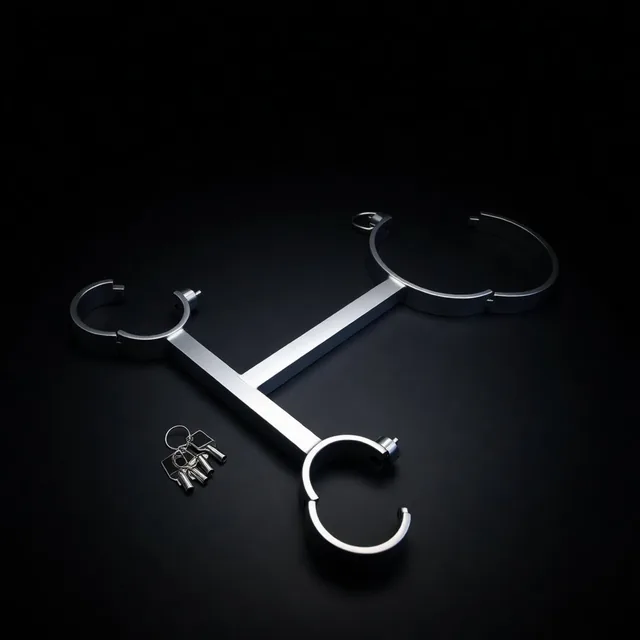
A yoke — sometimes called a pillory or a cangue — fixes the neck and both wrists in one rigid frame. It is the least-bought and most-misunderstood shape in metal restraint, largely because photographs make it look like an elaborate pair of handcuffs. It is not. It does something cuffs structurally cannot.
Cuffs restrain joints. A yoke restrains the relationship between them.
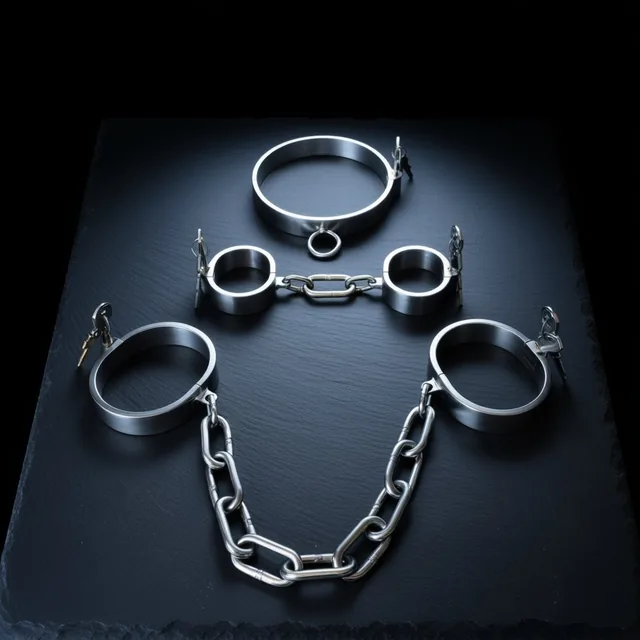
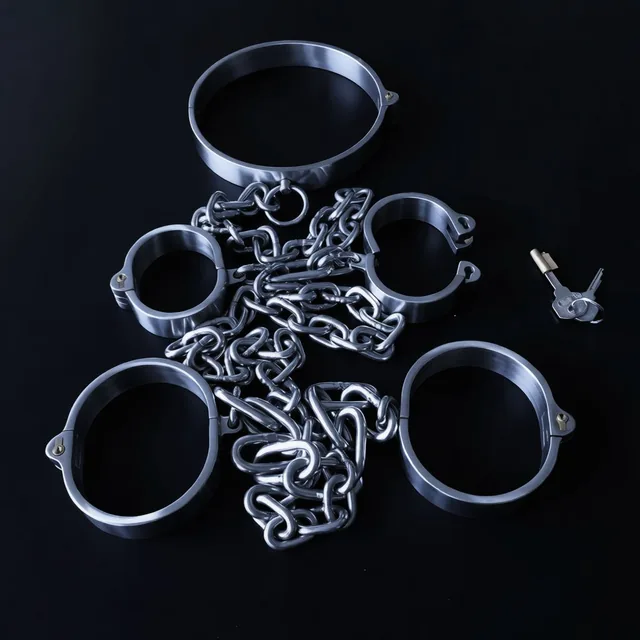
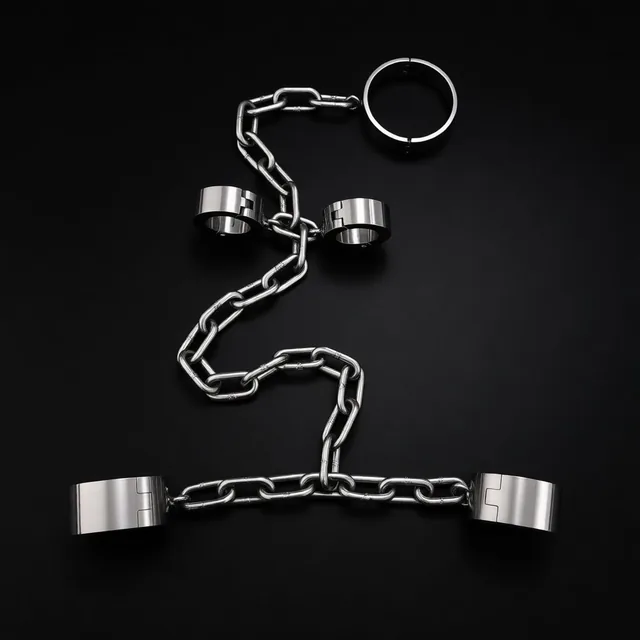
Wrist cuffs stop the hands separating. A collar stops nothing at all by itself. Put them together with a chain and the wrists can still travel — to the face, behind the back, down to the knees — because a chain only sets a maximum distance, not a position.
A yoke sets the position. Neck in the centre, wrists out at the ends of a bar, all three held at fixed distances from each other. The hands cannot reach the face, cannot reach each other, and cannot come down. The wearer can walk, sit and turn, and throughout all of it the arms stay exactly where the frame says.
Our Pillory yoke is the T-frame version — neck aperture 13.5 cm (women's) / 14.5 cm (men's), around 1.4 kg, closing on a press-lock that needs a key to open.
Why that reads differently
Two things about a yoke surprise people who are used to cuffs.
It is postural rather than tight. The restraint is in the geometry rather than in clamping force, and there is no way to work a hand loose by degrees. That does not mean pressure stops mattering: the wrist apertures are rigid steel, so a wrist that is too tight in one is exactly as much of a problem as it would be in a cuff. Check circulation and sensation at the wrists as you would with anything else.
It is visible from the front. Cuffs behind the back disappear. A yoke is the whole silhouette. That is either the point or the problem, depending on what you wanted.
The safety picture is different too
Because a yoke includes the neck, the rules tighten rather than relax.
- Clearance at the neck is two fingers, always. Never less, whatever the frame looks like when it is snug. The aperture is rigid: unlike a soft collar it will not accommodate a swallow, a cough or a change of posture.
- Balance is compromised. With the arms fixed out to the sides, a stumble cannot be caught. Yokes belong on carpet or a bed, in a room with nothing to fall against.
- Kneeling and lying down need planning. Getting up from the floor in a yoke is genuinely difficult; getting up from the floor in a yoke alone can be impossible.
- Never left alone. Never. This applies to everything we carry and it applies twice over to anything that includes the throat.
- Not load-bearing. No part of a yoke is rated to carry body weight or serve as a suspension point, and the neck aperture least of all.
Who it is actually for
A yoke is a second or third purchase, not a first one. It suits people who already know they respond to posture rather than pressure — the same people who choose a rigid bar over a chain — and who have a supervised setting and a soft floor.
If you are not sure yet, a rigid ankle set or a spreader bar gives you the same postural idea at a lower stakes level, and for a lot less money. The range is in heavy steel bondage sets.
The pieces this is about