Journal
Choosing a Spreader Bar Width
Updated
Before anything else: if you searched for a spreader bar and found hammock hardware and lifting equipment, you are not going mad. The term belongs to three unrelated industries, and only one of them means what you mean. This is about the adult restraint kind.
What the bar actually decides
A spreader bar sets a distance between two limbs and refuses to let it close. That is different from binding a joint. A cuff limits one thing; a bar fixes a posture at limb scale, and posture is much harder to take back than a grip.
Which means the width is not a comfort setting. It is the entire product.
Start at the narrowest setting
Start at the narrowest setting the bar offers, whatever that number is. Not because it is a magic width — a spreader set between the ankles is wider than shoulder width by definition — but because it leaves some balance available and is the easiest stance to kneel from. How long any setting stays comfortable is individual. Open it a position at a time, on separate occasions, and stop where the wearer says rather than where the bar runs out.
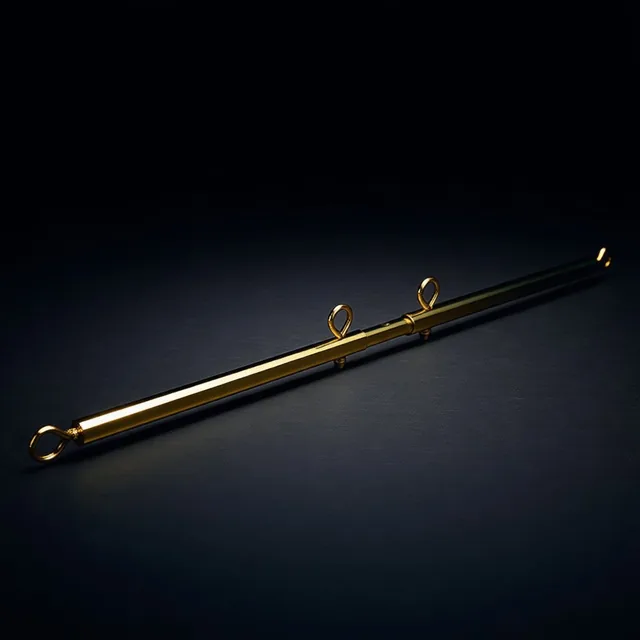
Our Vantage locks at seven positions between 62 and 93 cm for exactly this reason — you start at the bottom and open it a position at a time on separate occasions, rather than guessing once.
The top of the range is further than most people want
At the wide end of any adjustable bar, the limiting factor stops being the bar and becomes hip and shoulder mobility. Two people of the same height can differ enormously here, and neither of them can tell in advance from a number in a listing.
Signs you have gone a position too far: the knees rotate inward, the lower back arches to compensate, or the wearer cannot hold the position without holding on to something. None of those are "stretch further" problems. Close it a position.
Ankles or wrists?
A bar between the ankles fixes a stance. A bar between the wrists fixes the arms out and away — a very different sensation, and one that puts the shoulders under sustained load rather than the hips. Shoulders tolerate less than hips do, so if you use a bar at the wrists, use a narrower setting and a shorter clock.
The Vantage takes four screw-in eyelet rings so it can do either, or both at once with a second set of cuffs.
Standing is where a fixed span is felt most
It is also where a fall becomes a fall taken without being able to step. If you use a bar standing:
- keep the setting narrow
- stay within arm's reach
- use clips rather than locks at the cuff ends so release is one movement
- have something soft behind, not a coffee table
Practical fit notes
- Measure nothing; feel everything. Unlike a collar, the bar is not sized to the body. Set it, try it, adjust it.
- Cuffs matter more than the bar. The bar cannot be uncomfortable; the cuffs at its ends can. Leather spreads load; steel does not.
- Nothing is load-bearing. No bar we sell is rated to carry body weight or serve as a suspension point, whatever it looks like it could take.
Bar only, or a kit?
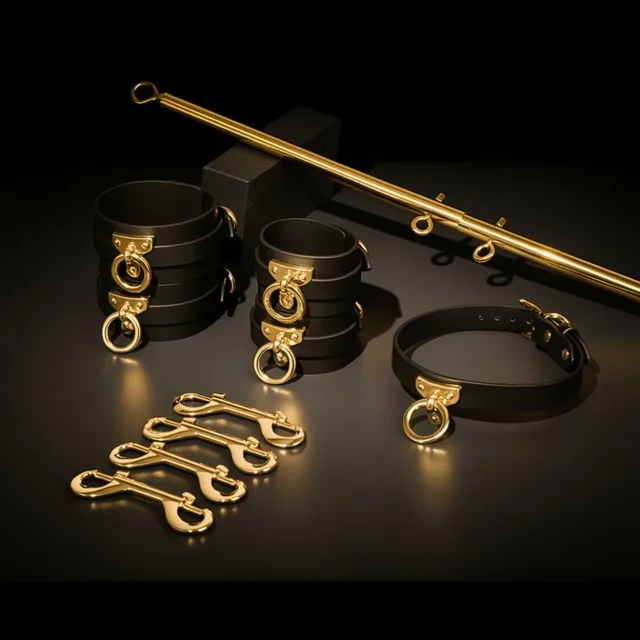
If you already own cuffs and clips, buy the bare bar and use them. If you would rather have one box that works, the Meridian is the same bar supplied with four leather cuffs and double-ended snap clips. Both are in steel leg spreader bars.
The pieces this is about
in Stainless Steel Spreader Bars — Adjustable Leg Restraint Bars